Pfiffikus
The Book ThiefPfiffikus is the nickname of an old man on Himmel Street whose identity is almost completely absorbed by his habit of whistling. He is remembered less through a private name than through a public performance: the Radetzky March carried into the street, children imitating it, and a torrent of abuse released whenever the imitation becomes a taunt. His comic appearance and violent temper make him a minor but sharply drawn figure, one whose repeated presence exposes the mixture of play, cruelty, conformity, and fear surrounding the neighborhood.
Identity and Appearance
Pfiffikus is described as a delicate-framed old man with white hair. His real name is unknown to the children, or at least unused by them; the nickname comes from his fondness for whistling. The name therefore functions as a social identity rather than a formal one. He exists in the neighborhood as a recognizable sound and silhouette, a person reduced to the behavior by which others know him.
His ordinary walk reinforces that impression. He bends forward, takes large, lanky steps, and keeps his arms behind his raincoated back. This posture suggests frailty, age, and a kind of habitual serenity. Yet the serenity is unstable. When someone calls to him or duplicates his tune, he straightens himself and answers with ferocious vulgarity. The contrast between the delicate frame and the force of the voice gives the character his grotesque comic energy: the body appears slight, while the language expands beyond it.
The Whistling Ritual
Pfiffikus constantly whistles the Radetzky March, a tune familiar enough for the children of the town to recognize and reproduce. His whistling creates a recurring neighborhood ritual. The children call out to him, imitate the melody, and wait for the transformation that follows. His response is not a private complaint but a predictable spectacle, and the children treat his anger as part of the game.
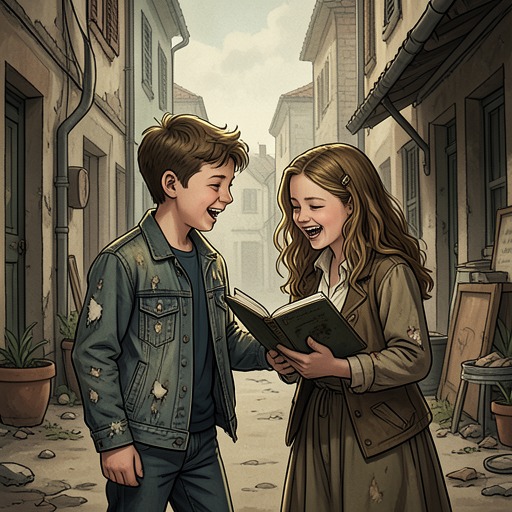
Rudy Steiner initiates one such encounter when he and Liesel Meminger are waiting on Himmel Street for their usual soccer game. They are early, and Pfiffikus is the only person nearby. Rudy points him out, calls to him, and begins whistling. Liesel follows almost reflexively, echoing the nickname and adopting the cruelty expected of childhood, despite her poor whistling. The scene establishes Pfiffikus as a catalyst for the children’s shared mischief: he is not merely observed but used as an occasion for imitation, daring, and belonging.
The exchange also reveals how cruelty can become communal entertainment. Pfiffikus’s rage is genuine, but the children’s imitation turns it into a repeated performance. His anger interrupts the impression of calm that his walk and tune create, making the street’s ordinary life oscillate between harmless play and deliberate provocation.
Public Conduct and Nazi Surroundings
Pfiffikus’s presence becomes more disturbing during the Nazi book burning. After the flames have died down, Liesel remains on the steps waiting for Hans Hubermann, watching ash and the remains of the collected books. The crowd has mostly disappeared, and the event is already being reduced to cleanup and forgetting. Among those who leave, Pfiffikus is especially striking: he has white hair, wears a Nazi uniform, retains the same dilapidated shoes, and departs with a triumphant whistle.
The detail does not turn him into a major political actor, but it places his familiar neighborhood persona inside the public machinery of Nazism. The same man associated with a comic tune and obscene outbursts is also visibly aligned with the uniformed crowd celebrating burning books. His whistle thus changes meaning. In the street it belongs to a ritual of childish taunting; after the burning, it accompanies triumph over destruction. The recurring sound links ordinary local behavior with a larger culture of coercion and ideological celebration.
That contrast is central to Pfiffikus’s function. He is neither presented through an extended political biography nor separated from the social world around him. Instead, a few concrete markers—white hair, worn shoes, uniform, and triumphant whistling—show how authoritarian spectacle can be inhabited by familiar, even comic, figures from everyday life.
Conduct During the Air Raid
Pfiffikus later appears with the neighbors in the cellar during an air raid. Around him are the Steiner family and the Jenson family, while the people in the shelter remain nearly motionless, their bodies pressed together and their faces fixed in waiting. In this setting, the old man’s characteristic behavior is temporarily suppressed: he keeps himself from whistling.
The restraint matters because whistling is normally his defining action. In the cellar, however, the familiar sound would be out of place against collective danger. His silence makes the scene legible as a crisis in which neighborhood identities are suspended. The man who usually provokes attention through noise becomes one more frightened body among others, sharing the stillness and uncertainty of the shelter.
The moment also sharpens the contrast between his public aggressiveness and his vulnerability. On the street, he can straighten, swear, and dominate a brief encounter through language. In the cellar, the threat comes from outside the group, and profanity offers no protection. His withheld whistle becomes a small sign of fear, discipline, or both.
Narrative Function and Significance
Pfiffikus is built around a memorable contradiction: he is a comic fixture whose defining sound can signal either childish harassment or ideological triumph, and whose noisy temperament gives way to silence when danger becomes real. His sparse characterization is therefore not empty. Each recurrence revises the previous one. The children’s taunting presents him as an object of play; the book burning places him among those celebrating destruction; the air-raid shelter restores his humanity by showing him restrained within a frightened community.
His nickname, repeated tune, exaggerated walk, explosive swearing, uniform, and dilapidated shoes create a compact portrait of social life on Himmel Street. Through him, the narrative shows how the grotesque and the ordinary coexist: a man can be ridiculous in one moment, complicit in a public ritual of destruction in the next, and silent beside neighbors awaiting an air raid. Pfiffikus does not drive the main plot, but his recurring appearances give the street a living, unsettling texture and demonstrate how large historical forces pass through recognizable local bodies, habits, and voices.